
What Another Season of Waiting Actually Costs
If that garage door has been doing its job since the first Clinton administration, putting off a decision one more season isn't free. Every month of rain and damp adds moisture into seams and joints you can't see from the driveway. A photo-eye sensor that doesn't work isn't a minor inconvenience, it's the difference between a door stopping on its own and a door closing on a kid's bike, a pet, or a foot. The real cost of waiting isn't dramatic until the day it is.
The Honest Safety List: What to Retrofit Now
Not everything on an old door is a problem. But a few things are genuinely unsafe by today's standards, and they're worth fixing even if the rest of the door is fine.
1. Auto-Reverse Sensors
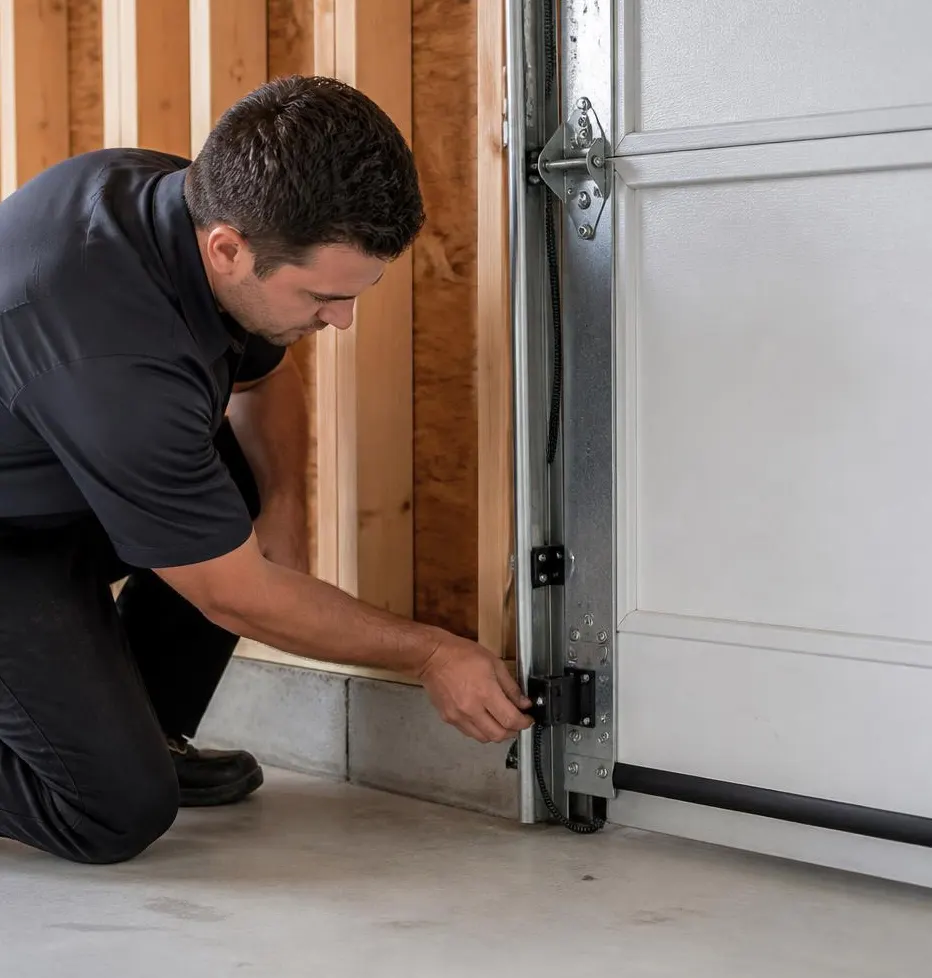
Openers made before the mid-1990s often shipped without photo-eye sensors or with a purely mechanical force-sensing reverse that's unreliable at best. If your opener doesn't have two small sensor eyes mounted near the floor on each side of the track, or if they're there but the door doesn't reverse when something blocks the beam, this is the single most important upgrade to make. It's inexpensive relative to everything else on this list and it's the one item that actually prevents injuries.
2. Exposed Torsion Springs
Older installations sometimes have torsion springs mounted without a safety containment cable running through the center. If a spring under that much tension snaps, the cable keeps it from becoming a projectile. Look for a cable threaded through the spring coil above the door opening. If it's missing, that's a retrofit worth doing on its own, independent of anything else.
3. The Wall-Mounted Button
Older push-button openers sometimes lack a constant-pressure requirement, meaning a single tap closes the door all the way with no way to stop it mid-travel without the remote. Newer wall controls restore that manual override and usually add a lock-out feature, which matters more than people think once kids are tall enough to reach it.
4. Cracked or Brittle Cables and Rollers
Steel cables that have started to fray, or nylon rollers that have gone brittle and chipped, are a mechanical failure risk, not just a noise problem. These wear out faster here than in drier climates because damp air accelerates corrosion on exposed metal. If you can see rust bloom on the cable strands or hear a rhythmic clunk as the door moves, that's wear, not character.
What's Fine to Leave Alone
This is the part that usually settles the argument, because it means you don't have to replace the whole door just because it's old.
- Solid wood or heavy-gauge steel panels that are structurally sound. If there's no rot, no delamination, and the door still hangs square in the track, the panel material itself isn't a safety issue. It's a cosmetic and insulation question, not a safety one.
- Manual lock mechanisms on the door itself, the kind with a sliding bar and a keyed cylinder. These still work fine as a supplemental lock and don't need to be removed just because they're vintage.
- The track and hinges, provided they're not bent, rusted through, or missing hardware. Realigning and lubricating an old track is often all it needs.
- A working chain-drive opener motor that's simply loud. Noise alone isn't a safety problem, it's a tolerance problem, and a quieter belt-drive unit is a nice-to-have, not a must-have.
In other words: the mechanism that stops the door from crushing something matters. The material the door is made of mostly doesn't, as long as it's not falling apart.
Where Weather Actually Changes the Calculation
Months of rain and damp air do two specific things to an old setup that are worth checking before winter storms arrive. First, wood panels at the bottom of the door, where splash-back collects, are the most common spot for rot and moss growth; press a screwdriver into the bottom few inches and see if it sinks in. Second, exposed steel hardware, tracks, hinges, cable ends, corrodes faster here than in a dry climate, and corrosion is what eventually causes the brittle-cable and stuck-roller problems above. A once-a-year check of these two things before the wet season settles in catches most of what turns into a bigger repair.
When to Call Federal Way Garage Door
If you've looked at the sensor situation, the spring cable, and the cable condition and you're not sure what you're seeing, that's a reasonable moment to get a second set of eyes on it rather than guessing. Federal Way Garage Door can run a full safety retrofit, adding modern auto-reverse sensors and spring containment to an older door, or handle spring replacement if the existing springs are worn past the point of a simple fix. Either way, you keep the door you've got instead of replacing it on a hunch.
If you're in Federal Way, WA or nearby and want someone to look at what's actually worth fixing on that older door, call Federal Way Garage Door and get it sorted before the next storm rolls through.